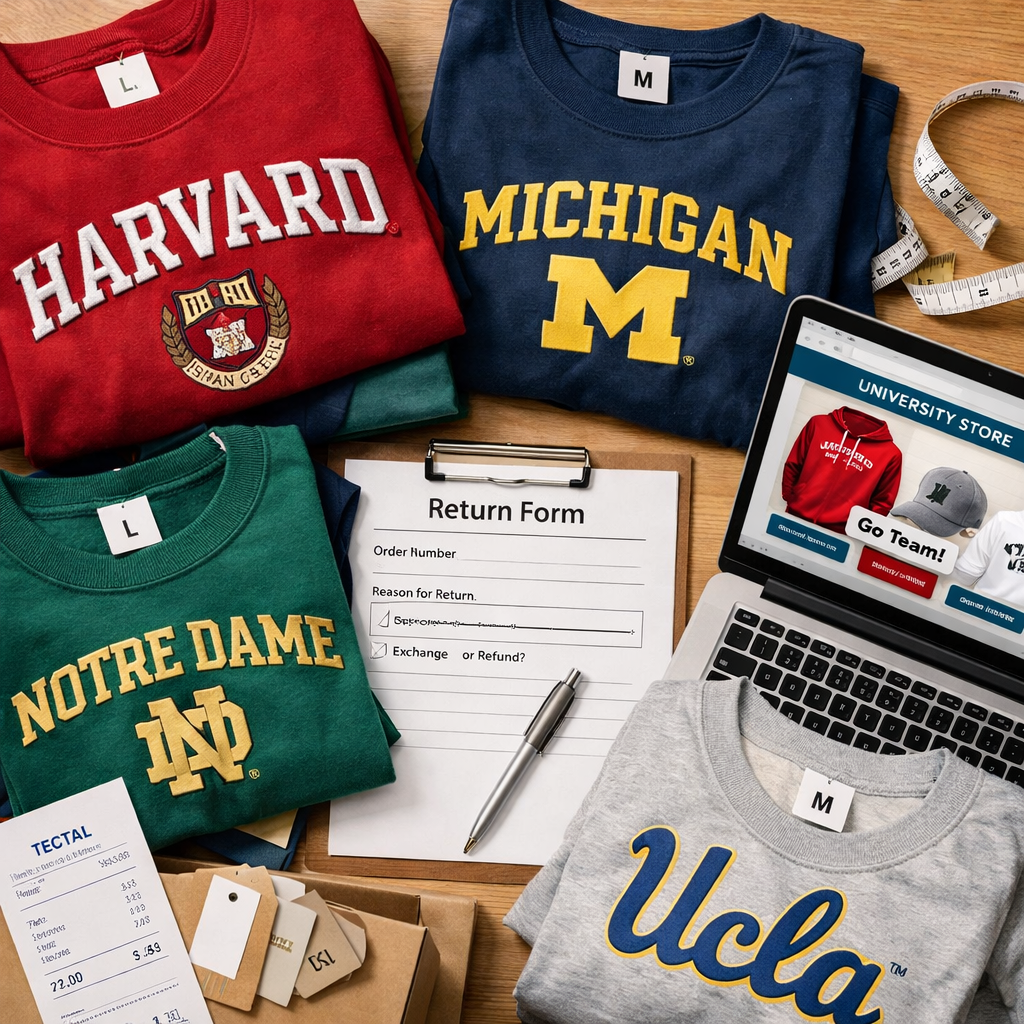
Official College Merchandise Guide: Trusted Stores, Return Policies, Sizing Tips
Getting official college merchandise shouldn’t be a guessing game. If you want the best place for college gear, start with official campus bookstores and athletics sites for guaranteed licensing, then branch to NCAA hubs for championship drops and big assortments. When you’re testing sizes, choose retailers with long, low-friction return windows and prepaid labels. In this guide, Wear Style Corner lays out trusted sellers, simple authenticity checks, the return-policy fine print that matters for apparel, and practical sizing tactics to reduce send-backs—so you get the right hoodie, jersey, or sweatshirt on the first try.
How to choose trusted sellers for official college gear
For licensed college apparel you can trust, prioritize these seller types:
- Campus bookstores and university webstores. These stores guarantee licensed marks and send royalties back to the institution. For example, the Swarthmore Campus & Community Store carries institution-linked tees, caps, and sweatshirts aligned with school standards and programs (see the Swarthmore Campus & Community Store).
- Conference and NCAA hubs. If you want championship merch and broad fan coverage across men’s, women’s, and kids’ categories, league-run storefronts centralize assortments across schools (browse NCAA.com).
- Athletic department and team sites. For team-specific assortments, color-accurate gear, and season updates, athletics domains are your one-stop (e.g., AuburnTigers.com).
Official college merchandise refers to apparel and accessories produced under a university’s or athletic program’s license. Products must use approved logos, colors, and marks, and come from authorized manufacturers. Licensing fees typically support the institution and athletics. Buying from authorized sellers helps avoid counterfeits and quality issues.
When in doubt about the best place for college gear, start at the campus bookstore or official team site, then compare prices, promos, and return perks at authorized retailers that clearly label NCAA gear and school licensing. Wear Style Corner’s roundups surface authorized options across these seller types to make comparisons simple.
Verify authenticity and licensing before you buy
Use this fast three-step path to avoid counterfeits and quality letdowns:
- Confirm seller status. Check for a campus store URL, an official athletics domain, or an NCAA-affiliated store page (e.g., the Swarthmore Campus & Community Store, NCAA.com, or AuburnTigers.com).
- Inspect licensing cues. Look for hologram or licensing tags, clean trademark usage, and accurate school colors/crests that match the university’s official pages.
- Verify contact and return channels. Credible stores publish complete addresses, customer-service contacts, and clear return terms.
Licensed apparel is clothing made by a manufacturer with formal permission to use a school’s trademarks. Licenses require quality standards, approved logos/colors, and royalty payments to the institution. Common indicators: hologram tags, official SKU stickers, and clear seller authorization. Wear Style Corner’s quick checks mirror these cues so you can confirm legitimacy quickly.
Risk tip: If authenticity is uncertain, buy from sellers with documented, flexible returns—Nordstrom’s widely cited case-by-case approach with no set time limit and convenient prepaid labels is a standout (see Refundly’s overview of flexible return leaders).
Compare return policies that matter for college apparel
Scan these terms before you add-to-cart: return window length, condition rules (unworn, tags), proof of purchase, refund method (original payment vs store credit), mail-return costs, and notable exceptions. The snapshot below summarizes common leaders cited for apparel-friendly policies. Wear Style Corner distills policy essentials to help you spot flexible terms fast.
| Retailer | Return window | Proof required | Condition | Refund type | Mail-return cost | Notable exceptions/notes |
|---|---|---|---|---|---|---|
| Nordstrom | No set time limit; case-by-case | Receipt helpful; lookup possible | Like-new; tags often required | Original payment or gift card if no proof | Prepaid label available | Designer/special items may have extra checks (see NerdWallet’s best return policies). |
| Costco | 100% satisfaction; most items anytime | Membership lookup | Opened often OK | Original payment | Free return shipping | Some electronics have shorter windows (see AARP’s list of top policies). |
| Zappos | 365 days | Order in account | Unworn with tags | Original payment or exchange | Free returns/exchanges | Worn/washed items not accepted (see Corporette’s return-policy roundup). |
| Target | Most items 90 days | Account lookup/no-receipt options | New/unopened; apparel standards vary | Original payment or store credit | May deduct return shipping | Category exceptions apply (see Refundly’s comparison). |
| Kohl’s | 180 days | Receipt or lookup | New/like-new | Original payment or merchandise credit | Customer pays if mailing | Premium electronics excluded/shorter windows (see Credit.com’s policy guide). |
| L.L.Bean | “Guarantee to Last”; generous coverage | Receipt or lookup | New/like-new | Original payment or store credit | ~$6.50 return shipping; waived for cardholders | Category safeguards; fair-use limits (see Credit.com’s policy guide). |
| Bloomingdale’s | Accepts most returns “anytime” | Receipt or lookup | New/like-new | Original payment or store credit | May charge return shipping | Category restrictions (e.g., mattresses) (see Credit.com’s policy guide). |
| Macy’s | Many gift returns anytime in-store | No receipt = lookup or lowest price | New/like-new | Original payment or store credit | May charge return shipping | No-receipt returns = lowest price in last 180 days (see Credit.com’s policy guide). |
A return window is the time period after purchase when you can send back items for a refund or exchange. For apparel, typical windows range from 30–90 days, though retailers often set different timelines by category or promotion (see SCORE’s primer on building return policies).
Trend check: Retailers have tightened policies as returns surged to an estimated 16.6% of U.S. retail sales in 2021, costing nearly $890 billion. More than 60% changed online return terms and about 67% now charge shipping or restocking fees in some cases, reflecting cost pressures and fraud controls (see Babson’s conversation on return policies and FIU’s analysis of policy shifts).
Policies change frequently. Always re-check the store’s current page before ordering.
Plan your sizing to reduce returns
Get fit right the first time with this quick flow:
- Start with the shop’s size chart. Compare garment measurements to a favorite at home—especially chest, shoulder, sleeve, and length for hoodies and college sweatshirts.
- Review on-model photos and multiple angles to gauge drape, stretch, and hem/sleeve lengths. Retailers that show real-model photography help cut sizing returns, according to Returnalyze’s guidance on managing size-related issues.
- Consider fabric behavior. 100% cotton may shrink; blends often hold shape. Scan product fit notes and reviews for stretch, weight, and jersey fit specifics.
Mini glossary
- Garment measurements: Flat measurements (chest, shoulder, sleeve, inseam) taken on the item. Matching these to a similar piece you own is the most predictable path to fit clarity.
- True to size (TTS): A fit that aligns with the brand’s chart without sizing up or down.
Keywords to consider as you shop: size inclusivity, hoodie sizing, material shrinkage. At Wear Style Corner, we put garment measurements first for reliable fit.
Order smart and keep return options open
- Test-and-verify sizing. If budget allows, order two adjacent sizes from sellers with friendly windows and prepaid labels; return the non-fit quickly. Keep items unworn and tagged to preserve eligibility.
- Confirm refund method. Some retailers default no-receipt or late returns to store credit to retain revenue as return costs rise (see Babson’s return-policy discussion).
- Mind the fine print. Final sale, worn items, and missing tags commonly void returns. Most apparel windows run 30–90 days (see SCORE’s return-policy overview).
Store credit is a retailer-issued value for future purchases instead of a refund to your card. Brands often prefer issuing credit to keep sales in-house amid rising return logistics costs.
Track returns and refunds to close the loop
- Initiate the return in your account and save the RMA, label, and deadline screenshot.
- Use carrier tracking; note the drop-off location and keep the receipt. Many retailers now use third-party drop-offs for convenience (e.g., UPS counters or partner stores).
- Set a calendar reminder for the expected refund-posting window; escalate with proof if delayed.
- Keep all order and return confirmations in a simple folder until the refund clears.
Retail operations note: High return volumes are pushing brands to monitor reasons closely and adjust policies; marketplaces may flag frequent issues, so documentation protects you if something goes sideways.
Wear Style Corner’s decision framework for best place to buy college gear
Use this 5-criteria scoring matrix (1–5 each). Add up scores for each source and pick the highest total.
| Criteria | Campus/University Store | Authorized Retailer | Marketplace | Secondhand |
|---|---|---|---|---|
| Authenticity & licensing proof | ||||
| Fit clarity (charts, model info, reviews) | ||||
| Return policy strength (window, labels, refund) | ||||
| Price & promotions (student deals, bundles) | ||||
| Speed & convenience (pickup, ship speed, drop-off returns) | ||||
| Total |
Typical picks
- Guaranteed authenticity and quick pickup: campus bookstore or official university site.
- Flexible try-ons/returns: retailers with long windows and prepaid labels (e.g., Zappos’ 365-day, free-return approach highlighted by Corporette).
- Broad selection and championship drops: NCAA.com.
If you want more school-by-school insights and outfit ideas, explore our college gear coverage at Wear Style Corner.
Frequently asked questions
How can I confirm a college item is officially licensed?
Buy from official campus bookstores, athletics sites, or NCAA hubs; Wear Style Corner’s guide covers what to look for, including hologram/licensing tags and correct trademarks. Authorized sellers publish clear return/contact info and use approved logos and colors.
What return policy details should I check before ordering apparel?
Confirm the return window, condition rules (unworn, tags), refund method (original payment vs store credit), and mail-return costs or prepaid labels. Wear Style Corner’s return-policy snapshots highlight category exceptions and note whether no-receipt returns default to store credit.
How do I pick the right size for hoodies, tees, and jerseys?
Compare brand size charts to a favorite garment’s measurements, review on-model photos and fit notes, and consider fabric shrinkage. Wear Style Corner’s sizing flow favors garment measurements, and if between sizes, choose the larger for cotton hoodies or order two sizes when returns are easy.
Is it better to buy two sizes and return one?
If the retailer offers prepaid returns and a friendly window, ordering two adjacent sizes can speed fit success. Wear Style Corner recommends keeping items unworn with tags and returning promptly to ensure a full refund.
What should I save to make returns fast and hassle free?
Wear Style Corner recommends saving order confirmations, receipts, return labels, and drop-off receipts, plus photos of product condition. Track carrier scans and set a reminder for the refund window so you can follow up promptly.